
Custom Table Covers for Trade Shows: Sizes, Types & Care Guide

Choosing the right table cover trips up more people than you'd expect — the wrong size, the wrong style, or a cover that looks sharp on day one and wrinkled by the second event. Most of it comes down to a handful of decisions made well before show day.
This guide walks through those decisions, so you can order the right size, the right style, and know how to keep it looking sharp for years.
What Size Table Cover Do I Need?
The answer depends entirely on your table, not your booth space.
Most trade show and conference tables in North America come in three standard sizes:
4 ft tables — common for smaller booths, registration desks, and school events
6 ft tables — the most widely used size at trade shows and conferences
8 ft tables — used for larger booths or when more product display space is needed
The key measurement isn't the tablecloth — it's the table. Measure the length, width, and height of your actual table before ordering. A standard 6 ft table is roughly 72" long, 30" wide, and 29-30" tall. A cover sized for a 6 ft table will look short and awkward on an 8 ft table, and vice versa.
If your table doesn't match a standard size — say it's a round cocktail table or a non-standard folding table, look for a supplier that offers custom dimensions rather than forcing a standard size to fit.
Fitted Table Cover vs. Table Throw: Which One Do I Need?
The answer comes down to how much of the table needs to be covered and how it will be used.
Table throws (also called table covers or tablecloths) are a single piece of fabric that drapes over the table on all sides, similar to a traditional tablecloth. They come in two styles:
Open back (3-sided) — leaves the back open so staff can quickly access supplies, boxes, or personal items stored underneath
Full back (4-sided) — covers all sides for a completely finished look, ideal when the booth will be viewed from multiple angles
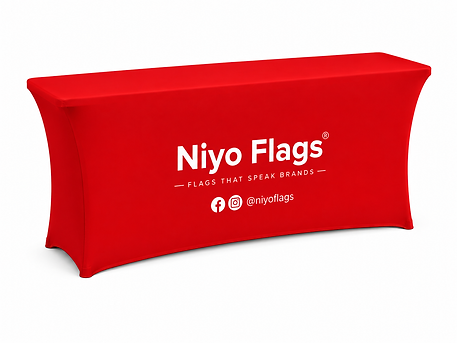
Fitted (stretch) table covers are cut and sewn to the exact shape of the table, similar to a fitted bedsheet. They sit snugly with no bunching or wrinkling, which gives a noticeably more polished, "box-like" appearance. These are generally the better choice when your logo needs to look sharp in photos or when the booth will be judged on visual professionalism, such as sponsor booths or product launches.
Quick rule of thumb: If you need quick setup, storage access underneath, and budget flexibility , go with a table throw. If you want the cleanest, most professional look for high-visibility events, go fitted.
What's the Difference Between a Table Runner and a Table Cover?
A table cover drapes the entire table. A table runner is a narrower printed strip that lays across the top of an existing tablecloth or bare table, usually used to add a logo without covering the whole surface. Runners are popular for registration tables or when a venue already provides linens and you just need branding on top.
How Do I Clean and Care for a Custom Table Cover?
Once the event is over, proper care is what keeps a cover looking new instead of faded or shrunken after a wash or two.
General care guidelines for printed polyester and stretch fabric table covers:
Machine wash in cold or lukewarm water on a gentle cycle with mild detergent
Avoid bleach or harsh stain removers, which can fade dye-sublimation prints
Tumble dry on low heat, or air dry when possible, and remove promptly to reduce wrinkles
Do not dry clean. Dry cleaning chemicals can damage printed and spandex fabrics, despite it seeming like the "safer" option, it often does more harm than a normal cold wash
Store folded (not crumpled) in a garment bag between events to prevent creasing and dust buildup
If a cover picks up a stubborn stain during an event, spot-cleaning with a damp cloth and mild soap immediately after the show is far more effective than letting it sit until the next wash cycle.
How Do I Stop My Table Cover From Wrinkling?
Wrinkling is one of the most common frustrations, especially with covers that get folded and stored for weeks between events. A few things help:
Choose a fitted/stretch style, which resists wrinkling far better than loose-draped throws
Store the cover on a hanger or rolled rather than tightly folded when possible
Steam (rather than iron) the fabric before an event — direct heat from an iron can damage printed graphics
Arrive early enough to let the cover "relax" on the table for 20-30 minutes before the doors open
What Material Should I Choose?
Most custom table covers are made from printed polyester or spandex-blend stretch fabric. Polyester is durable, affordable, and holds vibrant colors well, a solid default for most trade shows. Stretch/spandex fabric gives the tightest, wrinkle-free fit and is worth the upgrade for events where appearance matters most, like product launches or sponsor activations. For frequent outdoor use, ask about heavier denier fabrics, which hold up better to sun and handling than standard indoor-weight material.
Final Thoughts
At the end of the day, a table cover is a small purchase that does a lot of heavy lifting, it's usually the first thing a potential customer sees before they even make eye contact with your team. Getting the size right, picking the style that fits how you actually use the table, and taking two extra minutes to care for it properly is the difference between a booth that looks like an afterthought and one that looks like you meant business.
Before your next event, grab a tape measure, check your table's exact dimensions, and think about whether you need access underneath for storage. That five-minute step saves the hassle of a cover that's the wrong fit on show day.
Need a standard size? Check out niyoflags.ca to place your order directly. Need something custom, an odd table shape, a non-standard size, or a specific fabric request? Email us at sales@niyoflags.ca and our team will help you get it right.
Comments